

Forums vs Fora: Which Plural Is Correct? Meaning, Usage and Examples
Quick answer: Both are correct. Forums is the standard English plural and the best choice for general writing and online communities. Fora is the original Latin plural, and it fits formal, academic, legal, diplomatic, and historical writing. Pick one per document and stay consistent.
That settles the argument. If you only needed a verdict to fix a sentence, you can go back to your draft.
But if you have ever typed “fora” and watched your spellcheck draw a red line under it, or read a policy paper full of “multilateral fora” and wondered whether the author was showing off, stay a few more minutes. The forums vs fora question is small, yet it explains how English treats borrowed words, how the plural of forum works in different registers, and how to match your writing to your reader.
Forums vs Fora: The Quick Answer
Think of forums vs fora as a choice about audience, not a question of right and wrong.
Use forums when you are writing for a general reader: blog posts, emails, news stories, product pages, school essays, customer support pages, and anything about online communities. It is the plural most people expect, and it never looks strange.
Use fora when you are writing in a formal or specialized register: academic papers, legal documents, policy and diplomacy writing, or discussions of ancient Rome. In those settings the Latin plural reads as natural, even expected.
Whichever you choose, stay consistent inside one document. Mixing both in the same article is the one move in the forums vs fora debate that genuinely looks like a mistake.
Forums vs Fora at a Glance
| Forums | Fora | |
| What it is | The English plural of forum | The Latin plural of forum |
| Pronunciation | FOR-umz | FOR-uh |
| Tone | Neutral, everyday | Formal, scholarly |
| Typical use | Online communities, news, business, general writing | Law, diplomacy, academia, Roman history |
| Safe default? | Yes, for nearly every audience | Yes, within formal fields |
| Example | “She joined two photography forums.” | “The issue was raised in several multilateral fora.” |
What Does “Forum” Mean?
A forum is a place, real or virtual, where people meet to discuss matters of shared interest. The word has several closely related senses:
- A venue for public discussion. A town hall, a panel, a conference session, or a public debate.
- An online discussion site. A message board or discussion board where members post in threads, usually under the eye of moderators.
- A medium for public expression. “The newspaper’s letters page is a forum for local opinion.”
- A court or tribunal. In legal language, the forum is the place where a dispute is heard.
- The Roman Forum. The public square at the center of ancient Rome, which gave English the word.
What links all of these is the idea of a shared space where voices meet. That core idea survives whether the space is a marble square in the Roman Republic or a thread about home brewing at 2 a.m. on Reddit or Stack Exchange.
Where the Word Forum Comes From

English borrowed forum directly from Latin, where it meant an open public space, a marketplace, or a public square. In Rome, the Forum Romanum (the Roman Forum) sat in the valley between the Palatine Hill and the Capitoline Hill, and it was the center of public life. Speeches were delivered there, lawsuits were heard there, and markets and ceremonies took place there.
That legal side left a trace you can still see in English. The word forensic comes from the Latin adjective meaning “of the forum,” because legal arguments were once made in that public space. When a crime drama mentions forensic evidence, it is quietly naming a Roman square.
Rome also had more than one forum. As the old square filled up, Julius Caesar and later emperors such as Augustus, Nerva, and Trajan built forums of their own. Historians and archaeologists refer to these together as the Imperial Fora. This is a good example of the Latin plural doing a job that is hard to match in English: “the Imperial Fora” names a specific group of Roman monuments, while “the imperial forums” sounds like a generic list.
Why the Plural Is Fora
Latin nouns change their endings to show number and grammatical role. Forum is a neuter noun of the second declension, and neuter nouns in -um form their plural with -a. So:
- forum → fora
- datum → data
- medium → media
- curriculum → curricula
- stadium → stadia
When English borrowed forum, it brought the Latin plural along. That is why dictionaries accept fora as a plural. Pronunciation follows the Latin pattern as well: forum sounds like “FOR-um,” and fora sounds like “FOR-uh.”
One point matters here: fora is already plural. It is not a singular word, and it does not need an s. “A fora” and “foras” are both errors, and they usually come from writers who have seen the word but are not sure how it works. At its heart, forums vs fora is a choice between an English ending and a Latin one, and the Latin one cannot be made singular.
Why Forums Is Also Correct
English has a long habit of giving borrowed words regular endings. Once a word has lived in the language for a while and ordinary speakers use it daily, the simple -s plural tends to take over. We say stadiums more often than stadia, and museums, never musea. Nobody at the supermarket says campi for campuses.
Forum followed that path. Forums follows the standard English pattern, so it feels natural to speak and read, and it is listed as a standard plural alongside fora.
I remember marking up a student’s essay once and circling “fora” with a question mark, only to look it up and sheepishly cross out my own note. The student was right. That is a good reminder that “unfamiliar” and “incorrect” are not the same thing.
What Dictionaries Say About Forums and Fora
Major dictionaries, including Merriam-Webster, the Oxford English Dictionary, and the Cambridge Dictionary, record both plurals of forum. They treat forums as the regular English plural and fora as the Latin plural, and none of them marks either one as an error.
That matters because the forums vs fora question is often framed as a fight between “proper” and “improper” English. Dictionaries do not see it that way. They record how educated writers actually use words, and educated writers use both plurals. The difference lies in register and audience, not in correctness.
If a dictionary entry shows two plurals, the safest approach is to follow the one your publisher, university, or employer prefers. When no preference exists, choose the one that suits your readers.
Which Is More Common Today?
In everyday writing, and especially anything about online communities, forums is far more common. Search for discussion sites, community platforms, or message boards, and “forums” appears almost everywhere.
Fora has not disappeared. It turns up in academic papers, legal and policy documents, publications from international organizations, and historical or classical writing. Writers in those fields often choose it because it signals a formal register and because the Latin plural fits the Latin-influenced vocabulary around it: “fora for dialogue,” “multilateral fora,” “public fora.”
The rise of the internet gave forums a large boost. For millions of people, the word first arrived through discussion boards and community sites, not through Latin grammar, and so the English plural felt like the only plural. Usage still varies by field, publication, and region, so there is no single universal rule.
Why English Keeps Some Latin Plurals and Drops Others
If fora is acceptable, why does nobody say musea or campi? The short answer is that English has no rulebook for this. Each borrowed word follows its own path, shaped by who uses it and how often.
Words that live mostly in everyday speech tend to lose the Latin plural quickly. Museums, campuses, circuses, and stadiums all moved to the English -s ending because ordinary speakers wanted one simple rule. Words that live mostly in specialized fields hold on to the Latin plural longer, because the people using them were trained in Latin and Greek patterns. That is why you still meet curricula in education, formulae in some scientific writing, and fora in law and diplomacy.
Some words end up with both plurals, and the two forms drift into different jobs. Media now often refers to news and communication, while mediums is used in other senses. Fora and forums sit in a similar spot: same word, two plurals, different registers.
This history shows that fora is not a mistake that survived by accident. It is a form that stayed alive in the places where Latin-trained writers kept using it, while the English plural took over everywhere else.
Forums vs Fora by Context
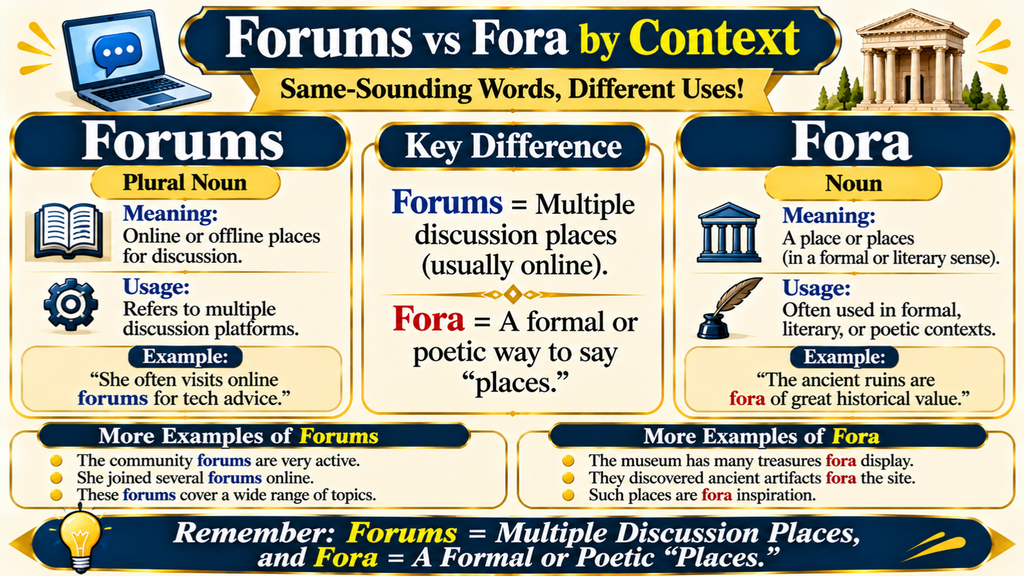
The best way to settle forums vs fora is to ask who is reading.
Online Forums and Message Boards
For anything about internet communities, use forums. Think of discussion boards, hobby communities, support groups, and sites in the style of Reddit or Stack Exchange.
- “She asked for advice on two gardening forums.”
- “The moderators removed three threads from the forum yesterday.”
“Online fora” is not wrong, but it sounds oddly stiff for something as casual as a thread about sourdough. Use it only if the rest of your writing is equally formal.
Academic Writing
Academic writing is mixed. Some journals and authors prefer fora for its formality, especially in the humanities, law, and political science. Others use forums because it is simpler and clearer for a broader audience.
When you are unsure, follow your target journal’s style guide or look at how recent articles in that publication handle it. And again: pick one and stay with it.
Public Fora and Legal Usage
Legal writing is where fora shows up most. In the United States, the “public forum” is a key idea in First Amendment law. Courts, including the US Supreme Court, use forum analysis to decide how much protection speech receives in different places. The standard categories are the traditional public forum (such as streets and parks), the designated public forum, the limited public forum, and the nonpublic forum. Lawyers and judges sometimes write about “public fora” in the plural.
Other legal phrases use the word too:
- Forum shopping: choosing a court where a case is likely to get a favorable result.
- Forum non conveniens: a Latin doctrine allowing a court to decline a case because another court is a more suitable place to hear it.
- Forum selection clause: a contract term that names the court or venue for disputes.
If you are writing for a legal audience, follow the conventions of that field. If you are explaining a legal concept to ordinary readers, “forums” is usually friendlier.
International Fora in Policy Writing
Diplomacy, development, and international relations are full of phrases like “multilateral fora,” “international fora,” and “regional fora for cooperation.” Think of bodies such as the United Nations or the G20 and the many meetings that surround them. In that world, fora is routine, and using forums would not be wrong, though it can read as slightly less formal.
Here is a quick comparison. A conference summary written for the general public might say, “Leaders met in several international forums.” A policy brief for officials might say, “States raised the issue in multiple multilateral fora.” Both are correct. They simply speak to different readers.
A related note: when a forum is a proper name, such as the World Economic Forum, the name stays as it is. Only use a plural when you are talking about more than one such event or body.
Roman History and Classical Studies
When the subject is ancient Rome, fora feels natural. “The Imperial Fora,” “the fora of Caesar and Augustus,” and “Rome’s public fora” all fit the Latin context. Many classicists and historians use the Latin plural almost automatically, though general history books for wider audiences often use forums instead.
Business, News, and Everyday Writing
In emails, social posts, product descriptions, student essays, news reports, and company blogs, choose forums. It is clear, familiar, and never draws attention to itself. Reserve fora for places where it adds precision or fits the surrounding tone.
I once edited a company blog where someone had swapped every “forums” for “fora” in a post about customer support communities. It read as if a Roman senator had taken over the help desk. We changed it back. The readers never knew, which is exactly the point.
Style Guides and Consistency
Style guides do not all say the same thing about forums vs fora, and some do not address it at all. If you write for a publisher, university, agency, or employer, check their house style first. If a style guide such as the Chicago Manual of Style, the AP Stylebook, or an APA-based department guide says nothing, fall back on two rules:
- Match your audience. General readers expect forums; specialist readers will accept fora.
- Stay consistent. Use one plural throughout a document. If you quote a source that uses the other plural, keep the quote exact and use your own plural everywhere else.
An editor will rarely correct a consistent choice. They will almost always flag an inconsistent one.
Other Latin Plurals That Work the Same Way
Forum is not alone, and the forums vs fora question has plenty of cousins. English has many Latin nouns that arrived with their own plural endings, and most now have an English alternative.
| Singular | Latin plural | English plural | Notes |
| forum | fora | forums | Both accepted; “forums” is more common in general writing |
| curriculum | curricula | curriculums | Both are standard; “curricula” is common in education writing |
| stadium | stadia | stadiums | “Stadiums” is far more common today |
| referendum | referenda | referendums | Both used; “referenda” is a little more formal |
| memorandum | memoranda | memorandums | Both appear; “memos” is the everyday shortcut |
| formula | formulae | formulas | “Formulas” is common; “formulae” appears in some scientific writing |
| appendix | appendices | appendixes | Both accepted; “appendices” is common for books and reports |
| medium | media | mediums | “Media” for news and communication; “mediums” for other senses |
| datum | data | datums | “Data” is the standard plural and now often treated as a mass noun |
A few take different Latin endings:
- alumnus → alumni (a graduate)
- bacterium → bacteria
- criterion → criteria
- syllabus → syllabi or syllabuses
Do not treat any single row as a universal rule. Each word has its own history, and usage differs between fields. The reliable habit is to look the word up and follow your style guide.
Plural oddities are not limited to Latin, either. Our guide to die vs dice shows how an everyday word ended up with an irregular plural, and penality vs penalty covers a spelling trap that also affects how you form the plural, penalties.
Example Sentences
Here are forums vs fora examples in real sentences, so you can hear where each one sits.
Forums:
- She spends her evenings answering questions on cooking forums.
- The company closed its old support forums and moved everything to a new community site.
- Three moderators manage the forums, and each handles a different topic.
- Students can ask for help on the course forums at any time.
- The museum hosts public forums on local history every spring.
Fora:
- The Imperial Fora in Rome show how emperors built new public squares beside the old one.
- Delegates raised the issue in several multilateral fora.
- Scholars have called these journals important fora for debate in the field.
- The committee recommended creating new fora for dialogue between regulators and industry.
- Courts have considered whether certain spaces are public fora for speech.
Singular, for comparison:
- A forum can be a physical place or an online one.
- The conference served as a forum for new ideas.
Forums vs Fora Comparison Table
| Feature | Forums | Fora |
| Type of plural | English plural (-s) | Latin plural (-a) |
| Tone | Neutral, everyday | Formal, academic |
| Common in | Online communities, general writing, news | Academic, legal, policy, historical writing |
| Reader expectation | Familiar to nearly everyone | Familiar to specialized readers |
| Example | “She joined two photography forums.” | “Both issues were raised in international fora.” |
| Pronunciation | FOR-umz | FOR-uh |
| Safe default? | Yes, for general audiences | Yes, within formal fields |
Common Mistakes People Make
Most errors around forums vs fora fall into a few patterns.
Treating fora as singular. “A fora” or “this fora is useful” is wrong, because fora is already plural. The singular is forum. “These fora are useful” works.
Adding an extra s. “Foras” is incorrect. If you want an English-style plural, write forums.
Mixing both in one document. If your introduction says “online forums” and your conclusion says “online fora,” readers wonder whether you changed your mind or lost track.
Using fora in casual writing. Technically fine, but it can sound stiff. If your post is about friendly hobby chat, “forums” fits better.
Getting the possessive wrong. Possessives trip people up more than the plurals themselves.
- Singular possessive: forum’s (“the forum’s rules”)
- Plural possessive of forums: forums’ (“the forums’ moderators”)
- Possessive of fora: fora’s is technically possible but looks awkward. Most writers rephrase: “the rules of the fora.”
Using an apostrophe to make the plural. “Forum’s” is not the plural of forum. “Two forum’s” is a mistake. Use “two forums.”
Assuming fora is always more correct. Latin origin does not make the Latin plural the “proper” one. English has its own grammar, and a borrowed word does not have to follow its source language forever.
Assuming forums is wrong. It is not an informal invention. It is a standard plural recorded in major dictionaries.
Misspelling it. “Forumes,” “forae,” and “foras” all show up in drafts. The accepted plurals are forums and fora, and that is all.
If you often second-guess spelling, a good habit is to verify any doubtful word before you publish. Our post on clarify vs verify explains how those two verbs differ and when to use each. For spelling variants that depend on region, see colonize vs colonise.
How to Remember Which to Use
Here is a simple rule that works in most situations.
Ask yourself: would a formal Latin-flavored phrase fit here? If yes (international fora, public fora, Roman fora), fora is a good fit. If the sentence is about everyday online discussion, forums is.
Another quick check: say it aloud. If “forums” sounds natural in the sentence, use it. If “fora” sounds natural, use that. Your ear is usually a decent editor.
A 30-second check. Before you hit publish, look at the sentence around the word. If it talks about a hobby, a customer community, a classroom discussion board, or anything casual, write forums. If it talks about treaties, courts, scholarly debate, or ancient Rome, fora will fit. If you cannot tell, write forums and move on. That one habit settles forums vs fora in almost every draft.
If you are unsure, choose forums. It is the safe default for almost every general audience, and no reader will think you made an error.
Other pairs that trip people up are covered in our guides to stub vs stud, lag vs log, and lyed or lied. Each one works the same way: the right choice depends on context, and a quick check beats guessing.
FAQs
What is the plural of forum?
There are two accepted plurals: forums and fora. Forums is the English plural and the more common choice in general writing. Fora is the Latin plural and appears mostly in formal, academic, and legal settings.
Is it forums or fora?
Either can be correct. Use forums for general audiences and online communities. Use fora when you are writing in a formal or specialized register that already leans on Latin-style vocabulary. That is the whole forums vs fora answer in two lines.
Is fora a real word?
Yes. It is the Latin plural of forum and is listed in standard dictionaries. If your spellcheck underlines it, that is usually because the tool is tuned for everyday writing.
Which is more common, forums or fora?
In general and online writing, forums is much more common. Fora appears more often in academic, legal, and policy writing.
When should I use fora?
Use it when the setting is formal and the audience will be comfortable with it: academic papers, legal writing, policy documents, or discussions of ancient Rome. If you are not sure, go with forums.
Is forums correct in formal writing?
Yes. Forums is a standard plural and acceptable in formal writing. Some fields simply prefer fora out of habit, so check the style guide for your publication or employer.
Why is the plural of forum fora?
Because forum is a Latin neuter noun ending in -um, and the plural of those nouns ends in -a. English borrowed the word along with its Latin plural, and then also developed the regular -s plural.
What does “public fora” mean?
It refers to public places or channels where people can speak and exchange views, such as streets, parks, or open meetings. The phrase is common in legal discussions of free speech, especially First Amendment law in the United States.
Is it “online forums” or “online fora”?
Almost always online forums. “Online fora” is understandable and not wrong, but it can sound stiff in everyday contexts.
How do you pronounce fora?
Fora is usually pronounced “FOR-uh.” Forums is pronounced “FOR-umz.” Some speakers vary the vowel slightly depending on their familiarity with Latin.
Can I use fora in an email or blog post?
You can, but it may sound more formal than you want. For most emails and blog posts, forums is the more natural choice.
Which plural is better for SEO?
People search for both, but forums is used far more often. If you write for a general audience, use the plural your readers are most likely to use, and mention the other form once so you cover both.
Final Thoughts
Forums vs fora is not a trap, and it is not a test you can fail. Both are correct plurals of forum. One is plain English and the other is Latin.
Use forums almost everywhere: online communities, everyday writing, general audiences, and anything where you want to sound clear and natural. Use fora when you are in formal territory (academic, legal, diplomatic, or classical) and the Latin plural fits the tone around it.
Pick one for each piece of writing and stick with it. Do not write “a fora,” do not add an extra s, and do not change your mind halfway through a draft. That covers nearly every mistake people make with this word.
If this cleared up forums vs fora for you, bookmark it for the next time a style question pops up in the middle of a draft. And if you enjoy untangling tricky word choices, there are plenty more in our Vs comparison guides and our Spelling guides.



2 Comments